Focused shockwave therapy is a non-invasive treatment that uses targeted acoustic or sound energy to stimulate the body’s natural healing response. It is commonly used for musculoskeletal conditions, particularly persistent tendon and soft-tissue problems.
How Does It Work?
Focused shockwave therapy uses concentrated acoustic waves to create controlled mechanical stimulation within targeted tissues. Through Mechanotransduction, mechanical force is converted to checmical signals that can influence biological activity within the body. This can trigger biological responses such as the release of growth factors and the formation of new blood vessels, which may support tissue repair, reduce pain, and improve function.
What is the Difference between Radial and Focused Shockwave Therapy?
Focused shockwave therapy sends energy waves that converge at a precise point deep in the body, so it can reach tissues several centimeters below the skin, like a calcium deposit in the shoulder or a slow-healing bone. Radial shockwave works more like ripples spreading out from a stone dropped in a pond: the energy is strongest at the skin and fades as it travels, which makes it well suited to broader, shallower problem areas like the arch of the foot or the outside of the elbow. Both aim to jump-start the body’s natural healing response, and your provider will choose the type based on how deep and how widespread your injury is.
What To Expect During the Treatment
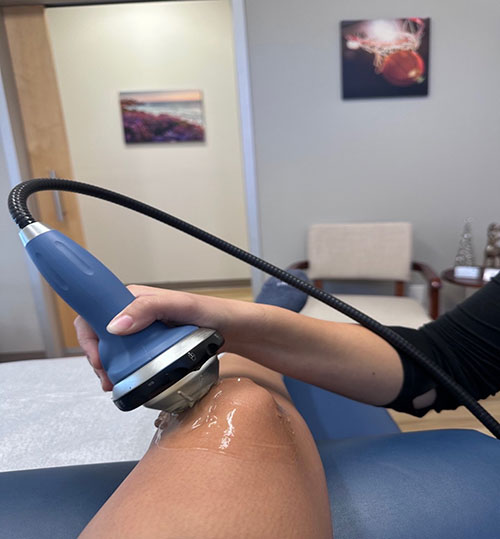
During a session, a handheld device delivers acoustic waves to the affected area. A conductive gel is applied to the skin to help transfer energy effectively.
The treatment intensity can be adjusted to suit the individual and the condition being treated. Sessions typically last around 15–30 minutes, with the number of treatments determined as part of an individual treatment plan.
What Conditions Can It Help With?
Focus shockwave therapy may be used as part of a treatment program for conditions including:
- Plantar fasciitis
- Tendinopathies
- Tennis and golfer's elbow
- Achilles tendinopathy
- Calcific tendinitis
- Certain non-union fractures
Because it is non-invasive, shockwave therapy does not require surgical incisions and generally does not require anesthesia. It may help reduce pain and support the body's natural tissue-repair processes.
Supporting Your Return to Activity
Ongoing pain can make it difficult to exercise, play sports, work, or enjoy everyday activities. Focused shockwave therapy may be incorporated into a wider rehabilitation programmed to help manage symptoms and support recovery. However, it isn't suitable for every condition. A professional assessment is important to determine whether shockwave therapy is appropriate for you.